






Newsletter Subscribe
Enter your email address below and subscribe to our newsletter

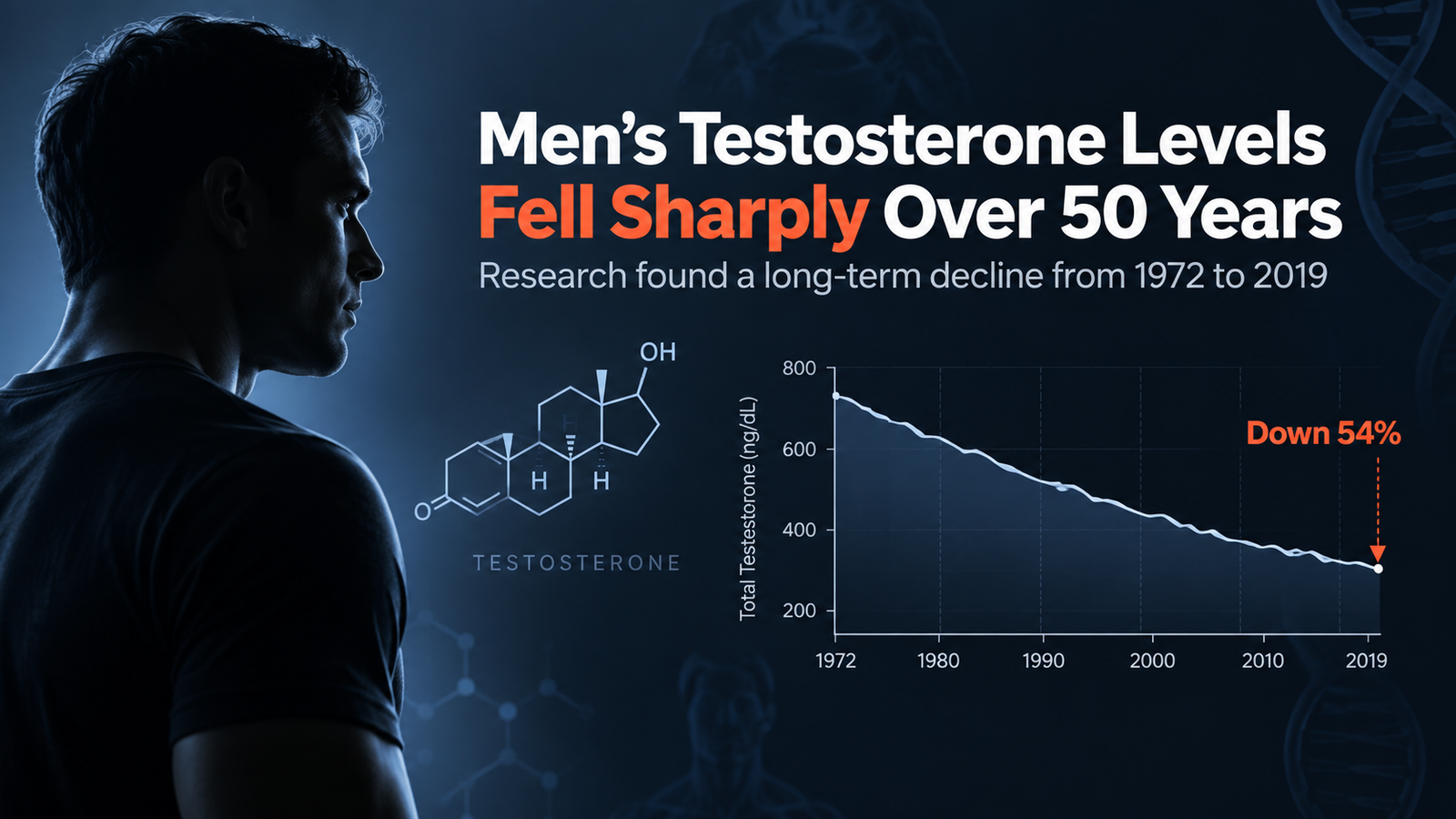

Declining testosterone levels in men have become one of the most closely watched trends in reproductive health research. Men’s testosterone levels appear to have declined substantially over the past several decades, according to new research presented in 2026 at the annual meeting of the European Society of Human Reproduction and Embryology.
Researchers analyzed studies covering testosterone measurements collected between 1972 and 2019 and found significant declines in total testosterone, free testosterone and sex hormone-binding globulin, or SHBG.
Media coverage of the research reported that average total testosterone may have fallen by approximately 54% over that period. Professor Hagai Levine, one of the researchers, described the findings as evidence of a serious deterioration in male reproductive health.
One of the most striking findings was that the downward trend became steeper after the year 2000.
According to the published conference abstract, total testosterone declined by approximately 0.17 nmol/L per year in studies with a median sampling year before 2000.
After 2000, the estimated annual decline increased to about 0.33 nmol/L per year—nearly twice as fast.
The researchers concluded that the simultaneous declines in total testosterone, free testosterone and SHBG suggest that the trend represents more than a simple change in how testosterone is transported in the bloodstream.
The study does not establish a single cause for declining testosterone levels in men. For more original research and history coverage, visit the Past Saga homepage.
One major possibility is the dramatic increase in obesity and metabolic disease during the same period. Obesity is strongly associated with lower testosterone levels, and Levine has suggested that obesity and metabolic syndrome could potentially account for a substantial part of the observed decline.
Researchers are also investigating other potential contributors, including:
However, none of these explanations has been proven to be responsible for the overall trend.
The published analysis specifically warns that differences in factors such as body mass index between populations could influence the results. Most of the available studies also came from wealthier countries, limiting how confidently the findings can be applied to the entire global male population.
No.
The findings describe a population-level trend, not what will happen to every individual man.
Testosterone varies substantially according to age, genetics, weight, health, sleep, medication use and numerous other factors. It would therefore be inaccurate to claim that every 30-year-old man today necessarily has lower testosterone than his father did at the same age.
What the research suggests is that, after accounting for age within the studies, men as a population are showing lower average hormone levels than comparable groups measured decades earlier.
Testosterone is involved in far more than sexual function.
It contributes to reproductive health, muscle and bone maintenance, red blood cell production and several other physiological processes. Persistently low testosterone can also accompany broader health problems.
That is one reason researchers consider a long-term population decline potentially important rather than simply a change in one laboratory measurement.
The research has attracted dramatic headlines claiming that male testosterone has simply “halved.”
The evidence deserves more careful interpretation.
The 54% figure was reported from the researchers’ conference presentation, while the published Human Reproduction abstract reports the trend primarily as an annual decline in hormone concentration. The abstract included 12 studies, seven countries and 102,334 participants and described significant declines from 1972 to 2019.
The work is also currently available as a conference abstract rather than a full research paper containing every methodological detail.
Some scientists remain cautious about broad claims of a global male reproductive crisis, arguing that differences between populations and study methods make long-term comparisons difficult.
The strongest conclusion is not that modern men have suddenly “lost half their testosterone.”
It is that multiple datasets confirm declining testosterone levels in men, a significant long-term decline in male testosterone levels, and the decline appears to have accelerated during the 21st century.
Exactly how large that decline is—and how much is caused by obesity, metabolic disease, environmental exposures or other changes—remains under investigation.
But the trend itself is substantial enough that researchers say understanding its causes should now be treated as an important public-health question.